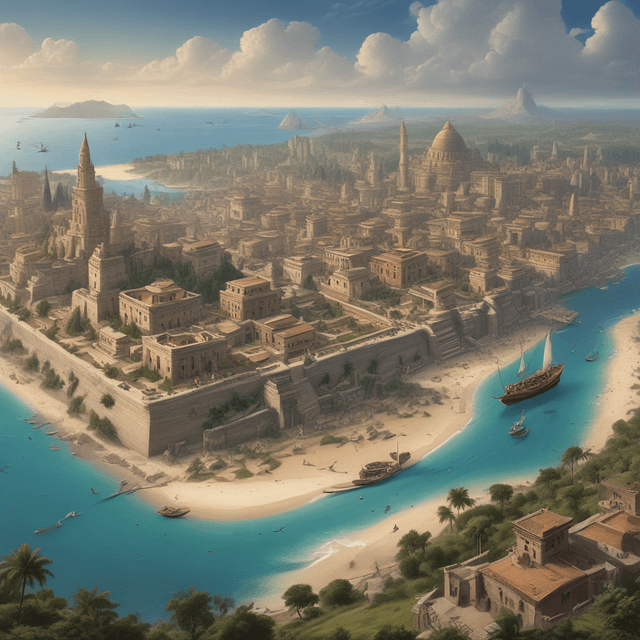
| Name | Limurian civilization |
| Period | c. 4000 BCE - c. 0 CE |
| Duration | Over 4,000 years |
| Location | Pacific Ocean, centered on the island-continent of Limuria |
| Influence | Shaped the development of many other Pacific civilizations |
| Characteristics | Highly advanced technology • Sophisticated urban planning • Spiritual philosophy • Political stability |
The Limurian civilization was a highly advanced ancient culture that emerged around 4000 BCE in the central Pacific Ocean. Centered on the vast island-continent of Limuria, Limurian society endured for over four millennia, making it one of the longest-lasting civilizations in human history. While largely unknown in the West, Limurian influence and technology profoundly shaped the development of many other Pacific civilizations.
Limuria was a massive continental landmass located in the central Pacific, over 3,000 miles wide. It was largely isolated from other major landmasses, situated roughly equidistant between the Americas, Australia, and Asia. The Limurian homeland featured diverse ecosystems, including expansive tropical rainforests, tall volcanic mountains, and fertile coastal plains.
Archaeological evidence suggests Limuria was first settled by Austronesian-speaking peoples around 5000 BCE. By 4000 BCE, these proto-Limurian cultures had coalesced into a sophisticated, technologically-advanced civilization centered on the sprawling capital city of Aloha. Aided by the island's abundant natural resources and isolation, Limurian society quickly flourished.
The Limurian state was organized as a technologically-sophisticated theocratic monarchy. At its head was the Akua-King, a divinely-ordained monarch who was both the political and spiritual leader. The Akua-King was advised by a council of high priests and scientist-engineers known as the Kahuna.
Beneath the Akua-King and Kahuna, Limurian society was highly stratified. A nobility class of landed gentry, bureaucrats and military officers dominated politics and the economy. A large merchant and artisan class provided specialized labor and expertise. At the base were peasant farmers, fishermen, and laborers.
Despite this hierarchy, Limurian civilization was remarkably stable and peaceful for most of its history. The Akua-Kings and Kahuna maintained tight control over the populace through a combination of spiritual indoctrination, advanced surveillance and communications technology, and a tightly-regulated economy.
Limurian technology was centuries ahead of contemporary civilizations in Eurasia and the Americas. They possessed an advanced understanding of mathematics, astronomy, physics, and engineering that enabled remarkable architectural and infrastructure feats.
Key Limurian technological innovations included:
The Limurians also made major advances in metallurgy, ceramics, and textiles. These technological breakthroughs underpinned Limuria's thriving economy and global trading network.
Limurian culture was highly sophisticated and centered on a complex spiritual and philosophical worldview. The Akua-King and Kahuna were seen as intermediaries between the mortal world and the realm of the divine, channeling the wisdom and power of the creator gods to the people.
Key elements of Limurian philosophy and religion included:
Art, music, architecture and even Limurian cuisine all reflected these spiritual and philosophical principles. Limurian culture deeply influenced the development of many neighboring Pacific civilizations through trade, migration, and cultural exchange.
In contrast to the rise and fall of ancient civilizations like Greece and Rome, Limurian society maintained its stability and technological sophistication for over 4,000 years. It was not until the 15th century CE that the first signs of decline began to emerge, as the arrival of outside European explorers and traders disrupted Limurian social and economic structures.
By the 17th century, Limuria had been conquered and colonized by European powers, leading to the gradual erosion of its once-dominant culture and technology. However, Limurian influence can still be seen in the art, architecture, and spiritual beliefs of many Pacific Island societies to this day.
Despite its obscurity in the West, the ancient Limurian civilization stands as a remarkable example of a highly advanced, technologically-sophisticated, and philosophically-oriented culture that was able to maintain stability and continuity for an exceptionally long period of history. Its legacy continues to intrigue and inspire scholars, artists, and visionaries around the world.
